In the beauty of the lilies Christ was born across the sea,
With a glory in His bosom that transfigures you and me:
As He died to make men holy, let us live to make men free,
While God is marching on!

. . . from the BATTLE HYMN OF THE REPUBLIC

Showing posts with label Movies. Show all posts

Wednesday, July 24, 2013

Movie Review: Copperhead

Recently my younger son and I went to the theater and saw the new movie Copperhead (official site; see also Facebook page and page on the Internet Movie Database). It is produced and directed by Ron Maxwell, who gave us the celebrated films Gettysburg in 1993 and (the somewhat less celebrated) Gods and Generals in 2003. But in my opinion, Copperhead stands even above those films in the quality of its production, acting, score, authenticity, and the power of its message. It's been in limited release thus far, so you may have to hunt for a theater to see it in (click here for links to lists of theaters, on-demand sources, and other viewing options). But the effort is thoroughly justified.

Ron Maxwell
In a recent interview, Maxwell explained that "In retrospect, looking back on it, I think the first two films [Gettysburg and Gods and Generals], taken together, are a cinematic meditation on why good men — honorable, ethical men — choose to go to war. . . .  The film Copperhead, which takes place during the same time, and with the same conflict, the American Civil War, explores cinematically why good and honorable, ethical, moral men choose not to go to war."

Copperhead is based on the 19th-century novel The Copperhead by Harold Frederic (1856-1898), who was born and raised in Utica, New York. Both the novel and the film are presented as based on actual events that took place in upstate New York in 1862 and 1863, during the first half of the American Civil War. The main character, dairy farmer Abner Beech, opposes the war being waged by President Abraham Lincoln in the name of preserving the Union. Like other Northern "Peace Democrats," Beech is contemptuously labelled a “Copperhead”--a poisonous snake--by those who ardently support the war and regard his stance as unpatriotic and even treasonous. Peace Democrats like Beech accepted the label, reinterpreting the copper "head" as the likeness of Liberty, which they cut from copper pennies and proudly wore as badges.

A cartoon appearing in Harper's Weekly, February 28, 1863,
disparaging Peace Democrats as "Copperheads"
 Some historians suggest that Copperheadism represented a traditionalistic element in the American population, alarmed at the rapid modernization of society as promoted by the Republican Party, and hearkened back to "Jeffersonian" and "Jacksonian" Democracy for inspiration. While nominally supporting the Union, Copperheads strongly opposed the Civil War, for which they blamed radical abolitionists, and sought immediate peace with the Southern states, whether they stayed in or out of the Union. They regarded the policies of President Lincoln and the Republican Party as arbitrary and tyrannical, and in direct conflict with the letter and spirit of the United States Constitution. Given Lincoln's suspension of habeas corpus, arrest and detention without trial of thousands of suspected secessionists in the border states, and other war measures of debatable legality--including, perhaps, the Emancipation Proclamation--there may have been more than a little merit in their position.

Billy Campbell as Abner Beech
But the film Copperhead does not dwell so much on legal issues, politics, or even the Civil War, as it does on how such contentious matters can divide a community and turn neighbors--and even members of the same family--against each other, with tragic results. Most of the people in the rural village where Abner Beech lives strongly support the Union effort against the South, especially Jee Hagadorn, an ardent abolitionist and father of the young lady Esther that Beech's son, Thomas Jefferson Beech, is courting. Neither Abner nor his neighbors are hesitant about expressing their opinions--more or less civilly, at first, but with increasing rancor as the film goes on. Peer pressure and a festering conflict between him and his father eventually impel Tom (or Jeff, as Abner prefers), to enlist in the Union army.

Marching village recruits off to war
In the months that follow, the villagers crowd anxiously around posted boards listing the names of local soldiers killed, wounded, and missing in action. They try to go about their daily work, but tempers fray as emotions build, and the village nearly plunges into a civil war of its own when neighbors confront each other while assembling to cast their votes in the contentious general election of autumn 1862. Not long after, Esther Hagadorn visits the Beech home seeking news of Tom on the very night that torch-wielding villagers, enraged by Abner's stubborn, outspoken Copperheadism, converge on the house--with potentially terrible consequences for both the Beeches and the Hagadorns. Only in the end do the neighbors confront what their once-peaceful community has become, and start mending the wounds.

Jee Hagadorn confronts Abner Beech
No capsule summary of a film's plot can adequately convey its power, though. In Copperhead, sights and sounds work together with the intimacy of the small village to make the viewer feel as if he or she is right there among these modest working people, sharing their passions and their fears. Though the story is set in upstate New York, the film was shot in the countryside of New Brunswick, Canada and particularly Kings Landing Historical Settlement.  I could recommend several venues in upstate New York where the movie might have been shot with at least equal faithfulness to the time and place being portrayed, so I'm not sure why New Brunswick was chosen (lower taxes comes to mind). Nevertheless, that location seems to share much with rural east-central New York in terrain, vegetation, and climate. I've traveled about that part of the state, now live in a west-central farm/college town in New York, and  grew up in a small western-New York town, and felt while watching the film that I was witnessing life as it must have been like right there where I had lived. The movie is filled with scenes of common people at their daily tasks, carried out just as people would in the mid-19th century--milling lumber; caring for livestock; gathering crops; building and repairing homes; attending to business in their little stores and workshops; attending church services and singing hymns; eating together around the table. From my own experience in living history, the costuming appeared to be thoroughly accurate and made the actors and the time they were portraying come vividly to life. The lighting and cinematography are gorgeous and bring the viewer right into story, so that you can almost smell the woods and fields and feel the warmth of the setting sun. The musical score, while not presenting any really memorable themes, was quietly beautiful and lent great dignity to the way of life carried on by the people of the village.

A domestic scene  from Copperhead
 Though most of the leading actors in Copperhead (including Billy Campbell as Abner Beech and Angus Macfadyen as Jee Hagadorn) have respectable filmographies, none is a household name--except Peter Fonda, who turns in a nicely understated performance as the blacksmith Avery. All of the acting is skillful and authentic, and much of it very poignant. Many of the actors are young and just getting started in film, but give wonderfully passionate and sensitive performances. The relative obscurity of the cast is an advantage, in my opinion, as we can interact with the characters as portrayed and without the baggage that big names inevitably carry to the screen.

Esther Hagadorn and Tom Beech
Some have criticized Copperhead  as "slow-moving," especially early in the film, but I think such care was necessary to introduce and fully develop the characters and the film's sense of time and place. The pace of life in a small, rural, 19th-century community was itself slow, and the character of the people emerged only in the measured rhythm of their daily lives. Much action and sudden, high emotion early in the movie would have run against its carefully crafted texture.

The central theme of Copperhead is what can happen to ordinary people when we let our differences ripen into hatred, and forget the counsels of brotherhood and compassion on which our Lord meant our lives together to be based. The lesson is exquisitely presented in James Chapter 3:
[T]he tongue is a little member, and boasteth great things. Behold, how great a matter a little fire kindleth! And the tongue is a fire, a world of iniquity: so is the tongue among our members, that it defileth the whole body, and setteth on fire the course of nature; and it is set on fire of hell. For every kind of beasts, and of birds, and of serpents, and of things in the sea, is tamed, and hath been tamed of mankind: But the tongue can no man tame; it is an unruly evil, full of deadly poison. Therewith bless we God, even the Father; and therewith curse we men, which are made after the similitude of God. Out of the same mouth proceedeth blessing and cursing. My brethren, these things ought not so to be. . . . But if ye have bitter envying and strife in your hearts, glory not, and lie not against the truth. . . . For where envying and strife is, there is confusion and every evil work. But the wisdom that is from above is first pure, then peaceable, gentle, and easy to be intreated, full of mercy and good fruits, without partiality, and without hypocrisy.  And the fruit of righteousness is sown in peace of them that make peace.  (James 3:5-10, 14-18)
Would that people today take this teaching to heart!  The tenor of our times is remarkably similar to that prevailing mid-19th century America. We are riven with fear, conflicting values, political faction, corruption, and controversy, which paralyze government and make enemies of neighbors and even family members. Instead of reaching out to and caring for each other as unique, priceless children of God, we seem more intent on "winning" the "culture wars,"  whichever side of those we happen to be on. We are divided and pitted against each other by self-serving media, interest groups, politicians, and professional grandstanders. Our country seems every day on the verge of a real, not just a figurative, civil war. In this poisonous climate, we do well to reflect on the lessons presented in a film like Copperhead.  I urge everyone to see it.

Abner Beech embracing his sons.

Sunday, January 13, 2013

Why Me, Lord?


To slightly paraphrase the old hit song by Kris Kristofferson:

Why me, Lord? What have I ever done to deserve even one of the [blessings] I've known?

Every day, I am astonished at all the blessings the Lord has bestowed on me: wise and loving parents; a sweet, patient wife who raised with me three fine children; reasonably good health; a stable, satisfying job; living in a free country . . . the list goes on and on. Of course, the greatest gift of all is God's infinite love in sending His Son into this world to live, teach, suffer, and die in ransom for my sins--the just for the unjust--so that I may live eternally in the company of Him and my loved ones. I don't think anyone has ever been more richly blessed than I.

I was reminded of that recently when my wife and I had the opportunity to travel from our home in upstate New York to Idaho, to spend a few weeks during the Christmas season helping our daughter Donna and son-in-law Jonathan care for their newborn twin children--their first, and our second and third grandchildren. These two came after years of trying, crying, and prayer by their parents, and were the most wonderful blessing (and Christmas presents) God could have given them.


Nothing has ever touched and engaged me more than holding those precious new babies in my arms, gazing into their bright, curious eyes, and even feeding and diapering them--whatever the hour!


Nothing has delighted me more than my wife Melany's beaming face as she embraced these little miracles, thanking the Lord for answering our children's prayers.


I was struck by how a loving and giving family like this is an echo of our Heavenly Father's relationship with us--how helpless and dependent on Him we are, how utterly selfless and infinitely generous He is toward us, even when we go astray. He would, and did, give his very life for us, just as our children would for theirs.

I feel so unworthy of His boundless grace. Of course, we can never be fully "deserving" of all God's blessings. If that were possible, we would be "earning" them through works in contravention of the teaching that salvation, like other blessings, comes by grace through faith--lest we should boast (Ephesians 2:8,9). "A faithful man shall abound with blessings" (Proverbs 28:20), and surely a steady faith in God and obedience to His commandments will bring those spiritual and familial blessings that the commandments were intended to secure to us, if not all the worldly benefits men desire.  I know that I am not always faithful to my heavenly calling, and I am too often disobedient. Yet God blesses me still, and remembering this keeps me in humble awe and deepest gratitude. If I never fully "deserve" His gifts, I can at least strive to live worthily of them.

While we were staying with Donna and Jonathan in Idaho, we watched the movie White Christmas. One of its best moments is Bing Crosby singing to Rosemary Clooney (and she singing back to him) the song "Count Your Blessings (Instead of Sheep)."


When I'm worried and I can't sleep
I count my blessings instead of sheep
And I fall asleep
Counting my blessings

When my bankroll is getting small
I think of when I had none at all
And I fall asleep
Counting my blessings
One of the things Crosby's character, an entertainer, wants most in life is to settle down and have a family. Thus the lines immediately following these is especially poignant:
I think about a nursery and I picture curly heads
And one by one I count them as they slumber in their beds
So, when I count my blessings, I'll always remember all my grandchildren's (someday) curly heads, resting on their pillows in slumber, and thank our Heavenly Father for them and for all the countless ways He's graced me with more than I'll ever deserve.

Liam Fleming


Brandon and Kate Randall

Sunday, September 4, 2011

Western Adventure 2011

We've been back in Brockport three weeks since returning from this summer's Western adventure in and about Idaho Falls, Idaho with our daughter Donna and her husband Jonathan. As always (click here for posts detailing previous visits), we had a marvelous time!

Hill Aerospace Museum

As we did last year, we stopped at Hill Aerospace Museum near Ogden, Utah on our way north to Idaho Falls, after Donna and Jonathan picked me up from the airport in Salt Lake City on Saturday August 6 (Melany went out a week before I did, so she was already there). The girls detoured to a nearby fabric store while Jonathan and I explored the museum (who do you think had the REAL fun?) I got some terrific photographs, this time of planes that didn't make it into last year's collection:

Here is Jonathan standing beside a Vought A-7 Corsair II,
a carrier-based subsonic light attack aircraft
that served the Navy during the late 1960s-80s.

You can see Jonathan at the extreme right,
just
below the wing of a Boeing B-52 Stratofortress,
a
long-range, subsonic strategic bomber that began service
in the 1950s and is still in use today.

Here's Jonathan standing beneath the nose
of another m
onster aircraft, the Douglas C-124 Globemaster II,
a heavy-lift military transport plane that served
the
Air Force during the 1950s and early 1960s.

Inside the museum, the nose of a Boeing B-17 Flying Fortress,
the premier Allied heavy bomber of World War II.

This is something you may not see anywhere else:
a full-scale model (made for a movie) of the
first atomic weapon,
nicknamed "the gadget,"
that was detonated at
the Trinity Test Site
in New Mexico on 16 July 1945.

The Farmers' Garden


On Sunday, after church, we went to visit Donna and Jonathan's friends the Farmer family--and are they aptly named! After a delicious dinner, we toured the extensive and stunningly beautiful gardens behind their home, complete with waterfalls, a fish-stocked pond, fruit trees, a large greenhouse, and thousands and thousands of flowers!


Donna and Melany in the Farmers' garden.

Fort Hall Replica

On Monday, we drove south to Pocatello, Idaho and visited the Fort Hall Replica. This is a full-size, faithful reproduction of the original Fort Hall built in 1834, which became an important trading post for the mountain fur trade and then for emigrants going west along the Oregon Trail (a few miles further up the Trail they had to make the fateful decision whether to take the north fork toward Oregon or the south fork toward California). As a matter of fact, before our vacation I had started reading an excellent book about the fur trade called Across the Wide Missouri by Bernard DeVoto--and at the time we visited the Fort was right in the middle of the book's discussion of the Fort's history!

A view of the Fort Hall Replica's interior.
It wasn't
a particularly big place, but "in the day"
would have
been crowded with people and animals.

Another view of the Fort Hall Replica's interior.
The building in the center was where most of the formal
"trading" was conducted.

This wagon, displayed at the Fort, is of the actual type
that carried most emigrants west along the Oregon Trail.
It's much smaller than the big "Conestoga"-type wagons,
often depicted as used by the pioneers in movies, that usually carried freight.

Take Me Out to the Ball Game!

Tuesday night we attended a delightful picnic put on by alumni of Brigham Young University-Idaho (which Donna and Jonathan both attended), then strolled over to a nearby stadium to see a game between the Idaho Falls Chukars (a "chukar" is a kind of partridge found in the Rocky Mountains) and the Casper, Wyoming (you know what's coming) Ghosts. The teams belong to the Pioneer League, a rookie league that's part of the Major League Baseball farm system. We must bring the Chukars good luck, because they won this game just like they did on our 2010 visit to Idaho Falls! And the most memorable moment of the night wasn't on the field: Jonathan and I each won a drawing for a prize from Deseret Books! We picked them up in the stadium gift shop, and I was astounded to get a book that I had just recently found out about and wanted badly to read, The Miracle of Freedom: Seven Tipping Points That Saved the World by Chris and Ted Stewart. A delightful evening indeed!

The Chukars warming up.


Aside from Jonathan and I winning prizes, this
was the night's most dramatic moment--out at home plate.

Yellowstone National Park

On Wednesday we drove to Yellowstone National Park and took the North Loop, instead of the South Loop which we had focused on in previous visits. Not far into the park we stopped to stretch our legs (having driven over two hours from Idaho Falls), opposite a high bluff overlooking a creek.

And there we encountered the little follow (gal?) below, who seemed to be looking for a handout or leftover--it's a marmot.


"Did all these people come here just to see me?"

One of the first major sites we came to was Norris Geyser Basin, an otherwordly expanse of steam vents, geysers, and hot acidic pools.

Norris Geyser Basin

A few miles further up the road we came to a place called Artist Point, from which we beheld the Lower Yellowstone Falls. What a spectacle! The water of the Yellowstone River plunges more than 300 feet into the Grand Canyon of the Yellowstone, which itself is up to 1,000 feet deep.

Lower Yellowstone Falls from Artist Point

Lower Falls and Grand Canyon of the Yellowstone

Donna and Jonathan at Artist Point

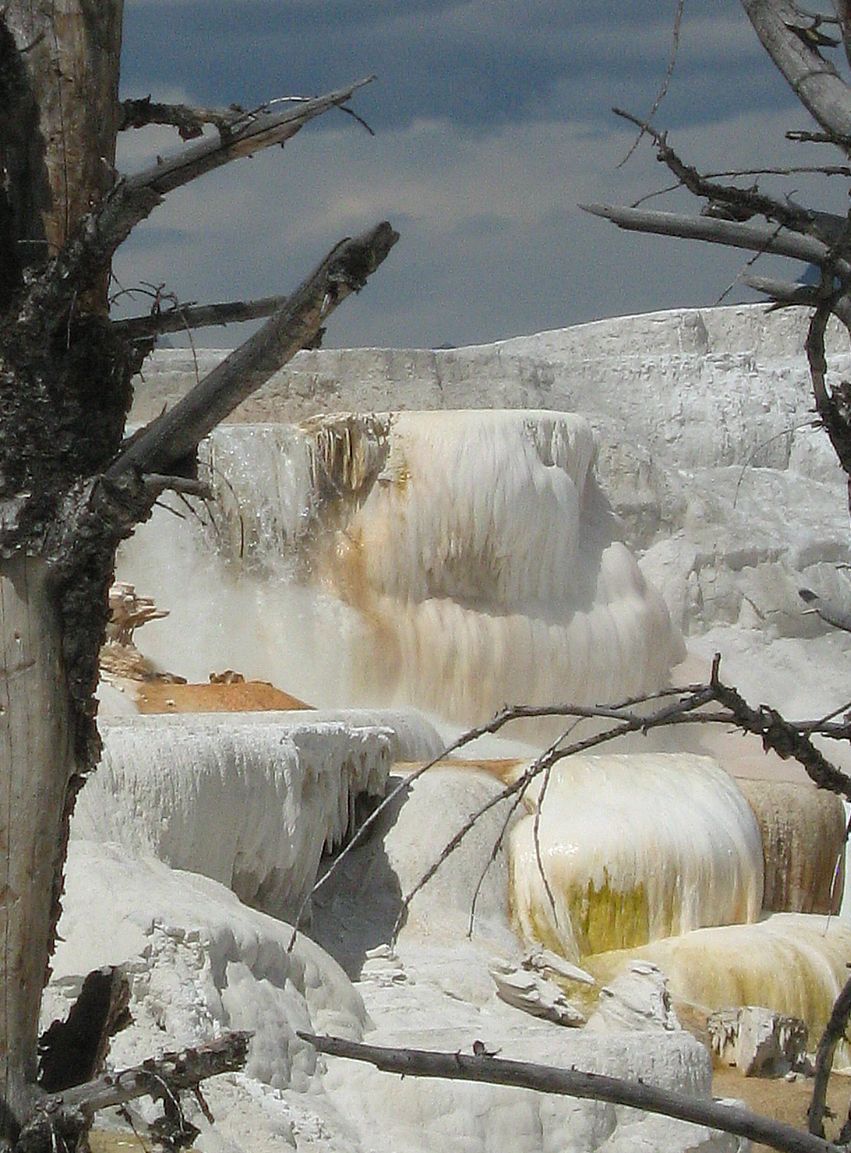
Further on we came to Mammoth Hot Springs, an area even more like an alien planet than Norris Geyser Basin. Here, hot water from the springs flows over the surface in rivulets and pools, and deposits calcium carbonate--a white, chalky mineral--in such copious amounts that it's formed terraces down the side of a hill that look like frozen waterfalls. The mineral and the hot water that leaves it thick everywhere choke the life out of any trees that try to grow here. I'll just let the camera take over for a moment to give you an idea what this place is like.


The rest our drive was through seemingly endless, and beautiful, hill country.


The rest our drive was through seemingly endless, and beautiful, hill country. One thing often seen in this area are buffalo--or "bison," as they're properly called.


Here's what one of these enormous, fearsome creatures looks like up close and personal--the picture was taken from just inside the car window! (I'm cheating a bit here; this photo was actually shot on our 2007 visit to Yellowstone, but is making its first online appearance--I couldn't resist!)


Playmill Theater

After leaving Yellowstone Wednesday evening we stopped for dinner in the town of West Yellowstone, Montana, and then attended a presentation at the Playmill Theater of the musical Dirty Rotten Scoundrels. It was a lot of fun, if not quite as delightful as Seven Brides for Seven Brothers, which we saw at the Playmill last year.

Temples and Temple Square

Whenever we're in Idaho and Utah--from which our plane left for home on Saturday--we enjoy visiting the sites associated with the Church of Jesus Christ of Latter Day Saints (LDS). Of course, that includes the Church's beautiful temples, including the new Rexburg Temple in Rexburg, Idaho, where Donna and Jonathan attended college at BYU-Idaho.

Rexburg Temple

Statue of the Angel Moroni,
atop the Rexburg Temple


Before we left for home from the Salt Lake CIty airport, we visited Temple Square in Salt Lake CIty--always a setting for marvelous pictures!

There were 75 weddings at the Salt Lake Temple
on the Saturday we were there--if you look closely,
you can see one of the couples in the lower right corner
of this picture (I didn't notice them till after I
took the picture!).

This side view of the Salt Lake Temple
was taken through a large window
from inside
the adjacent Visitors' Center.

17 Miracles

It's hard to overstate the crucial role the Mormons played in American history and settlement of the West. On Friday evening we all went to a showing of the film 17 Miracles, a beautiful, well-acted, and heartrending film about the Willie and Martin companies of Mormon pioneers, who pulled wooden handcarts across the American plains in 1856 toward the Salt Lake Valley, and were caught in the mountains of Wyoming in October, when winter came early and with a vengeance. Before they were rescued many died, and there was much suffering and much discovery of what faith, hope, and love really mean.


Conclusion

Melany and I tasted a little adversity of our own on the flight back home, when bad weather in Chicago held up our flight there from Salt Lake City, and we had to spend the night at O'Hare airport because our connecting flight to Rochester left about 20 minutes before we landed. After seeing what the Willie and Martin companies endured, what was a little inconvenience like that?

If you've never traveled out to see the great American West, this should definitely be on your "bucket list." Seeing places like Yellowstone, the Teton Range, the Snake River Valley, and Temple Square are priceless, unforgettable experiences. Melany and I are so thankful that Donna and Jonathan have made it possible for us to have them. Thank you both, again!

Idaho sunset