In the beauty of the lilies Christ was born across the sea,
With a glory in His bosom that transfigures you and me:
As He died to make men holy, let us live to make men free,
While God is marching on!

. . . from the BATTLE HYMN OF THE REPUBLIC

Monday, July 5, 2010

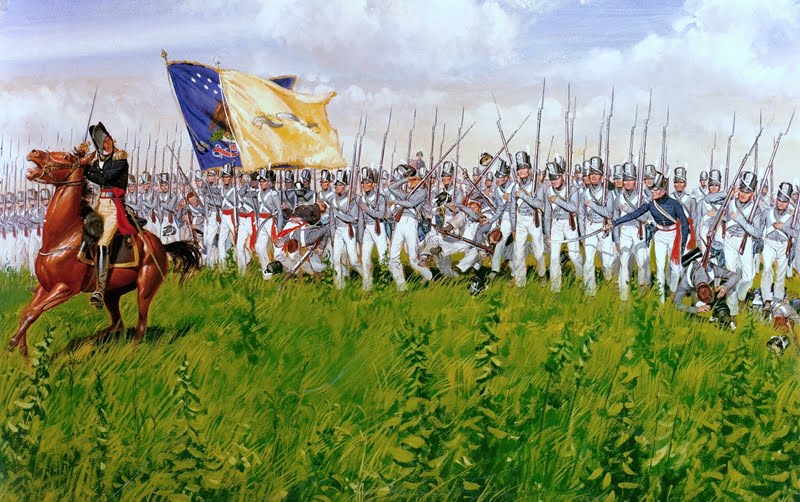
"Regulars, by God!"--The Battle of Chippawa

Today is the 196th anniversary of an important battle that, almost certainly, you never heard of: the Battle of Chippawa on July 5, 1814. It was part of the Niagara Campaign in the War of 1812, which aimed at seizing control of Upper Canada (the southern part of today's Province of Ontario) which, Americans widely believed, Canada's British masters had been using as a base for promoting and facilitating Indian attacks on American settlers moving into the Northwest Territory. That campaign proved to be the longest and bloodiest military operation of the War of 1812, and was decisive in determining the future political shape of North America.

The battle pitted about 3500 United States regular troops, militia, and Indians led by Brigadier General Winfield Scott--future hero of the Mexican-American War and commander-in-chief of all Union forces at the outbreak of the American Civil War--against about 2100 British regulars, Canadian militia, and Indians led by Major General Phineas Riall. The engagement took place across open fields a few miles south of the village of Chippawa on the Canadian side of the Niagara River just a short distance from Niagara Falls. This site is only about 3 miles, as the crow flies, from where I grew up on Grand Island, NY, which is located just across the Niagara on the American side (here's a map showing these locations). Had my family lived there at the time of the battle, I would have been able to hear the roar of cannon and the ripping of musketry from my house!

For several months prior to the battle General Scott had been drilling his green troops relentlessly in a camp at Flint Hill near Buffalo, NY, which town the British had burned to the ground just four months earlier. Scott recognized that without hard training and discipline his men would be in no position to face the British army, then the world's best. In a significant departure from frontier military practice at the time, he fought with army bureaucracy to ensure that the men were properly fed, clothed. and equipped, and enforced rigorous health and sanitary measures in the camp, which kept sickness to a minimum. His standards were thwarted only by the government's failure to supply the troops with proper blue uniforms; only short gray jackets typical of untrained militia were all that could then be provided.

To greatly simplify events: The Americans crossed the Niagara on July 3, and quickly captured British-held Fort Erie opposite Buffalo. On July 4, after firing a salute to America's 38th birthday, they moved north along the west side of the river and, late in the afternoon, encountered advance elements of Riall's force along Chippawa Creek. Following a brief exchange of artillery fire, Scott withdrew a few miles to camp along Street's Creek to the south. The next morning the British force advanced south and collided with Scott's brigade, which was just starting north. The clash opened with the American artillery battery all but wiping out out Riall's guns along the portage road along the river. Meanwhile, Scott formed his line into a "U" shape as the British line advanced, which allowed the American flanking units to catch Riall's advancing troops in a deadly crossfire. Riall had thought that the American line was composed of grey-clad militia troops apt to fall back in disarray after the opening volleys, but as Scott's men held steady under British artillery fire, Riall realized his mistake and supposedly exclaimed, "Those are regulars, by God!" After the two lines had punished each other with continuous volley fire for almost a half hour, at a distance of less than 100 yards, Riall ordered his men to withdraw back north. Only effective covering fire by British artillery kept the Americans from pursuing Riall's force all the way back to Chippawa (here's a detailed map showing locations and troop movements involved in the battle).

The British/Canadian/Indian force suffered an approximate casualty total of 106 killed, 325 wounded, and 90 taken prisoner---one-quarter of their entire strength. The American official casualty return stated their loss as 60 killed, 249 wounded and 19 missing, or slightly less than ten percent.

The two forces would meet again 19 days later and a few miles further north in the even more bloody Battle of Lundy's Lane, at the site of present-day Niagara Falls, Ontario. There too, the British/Canadian brigade would suffer a tactical defeat, although by this time American forces were so tired and depleted that they had to retreat back across the Niagara, without effecting the hoped-for conquest of Upper Canada.

Nevertheless, as noted by historian Donald E. Graves (the foremost authority on the Niagara Campaign), the Battle of Chippawa was the "first time during [the War of 1812] that American infantry had met and defeated British infantry in open battle." [Where Right and Glory Lead! The Battle of Lundy's Lane, 1814 (2d ed. 2003, p. 92)]. The American victory, made possible by General Scott's careful preparation of the troops at Flint Hill and his skillful leadership on the battlefield, showed clearly that the new nation's army had become a professional military force able to hold its own against the world's finest. Graves and many other historians thus suggest that Chippawa, rather than Valley Forge, might be considered the birthplace of the modern American army. Indeed, tradition has it that gray uniforms were later adopted for cadets at West Point--and are still worn today--in recognition of what Scott's brigade achieved at Chippewa.

So--WHY WASN'T I TAUGHT ABOUT THE BATTLE OF CHIPPAWA IN SCHOOL? On Grand Island, our little fannies were sitting not 5 miles from where the battle was fought! The main American force was led by a man who, cutting his teeth on that field as a newly-minted brigadier, later became one of the foremost military leaders in our nation's history! By the time of Chippawa there wasn't a corner of western New York that hadn't been hit hard by the war, between marauding British troops and refugees fleeing east by the thousands. The struggle along the Niagara in 1814 would determine the political future of this continent. And much of it happened literally in our back yards!

It's a shame that such events aren't taught more completely and effectively in our schools, especially when they're so immediate to the places where we live. If history is taught as if by reading from a telephone book--mere names, dates, places--young people (as well as old) can't help but be bored to death. They won't care about it and will never grasp the significance of what happened or be able to apply history's lessons in helping guide our country's future. But if history is made local and literally brought "home" to them--if it's made as familiar and immediate as their school building or the street on which they live--children will be captivated by how "real" it is and how directly it has affected their own lives. Only then will they gain the knowledge, experience, and perspective they'll need as future leaders to steer America on the right course.

POSTSCRIPT: You can visit the Chippawa Battlefield Park today and see the site almost exactly as it was on July 5, 1814--just an open field ringed by woods, yet now the eternal resting place for scores of men who fell that day, on both sides. An impresive monument (fittingly, one for both forces) commemorates their valor. I've been there, and the quiet is truly sobering when one thinks of the desperate struggle across that very ground so many years ago.

Sunday, July 4, 2010

HAPPY ANNIVERSARY!

Today is not only the 234th anniversary ouf our nation's founding, it's also the 29th anniversary of my family's founding (well, our little piece of the clan, anyway)! How ironic that Melany Dianne Spendlove and I tied the knot, and thus became forever dependent on each other, on July 4, 1981--"Independence" Day! That just happened to be the only Saturday in the mid-June-to-mid-July time frame that the that the minister and church we wanted for our wedding were available. What a wonderful day! Our families came down to Chattanooga, Tennessee where I was living and working at a law firm at the time, to share the event with us. We put the reception together ourselves, with lots of help from our kin, and stayed that night at the Chattanooga Choo Choo Hotel, in a luxurious Victorian railroad sleeping car (on a track by the hotel, not out in some grimy switchyard!). I couldn't tell you whether folks in Chattanooga were setting off fireworks that night, as Melany and I were too busy making our own! ;-)

That was only the first day of a journey together that will never end. Doesn't that give a dramatic perspective to one's wedding day?

I never stop marvelling at how miraculously improbable our union is. How did a the son of a milk truck driver/insurance salesman from western New York and the daughter of an auto worker from central Michigan get together, anyway (it's a long, amusing story)? We're so different--I was a timid, reserved, bookish, somewhat gloomy person, utterly lacking in practical skills, while she was (and still is) sunny, outgoing, optimistic, generous, and amazingly clever. And good. And wise. What on earth did she see in me? The wonderful thing is that we're still growing as people and discovering more and more of each other every day, even 29 years on. We help each other be all that we can be. Each of us feels like half a person when the other is away, and can't imagine life without the other. We've had at least our share of rough stretches along the way, thanks largely to our own shortcomings (well, mine anyway), but somehow we've managed to surmount them with faith, dogged commitment, and all the love we could muster. God willing, we'll have at least another 29 years here on earth to test and grow our skills as spouses!

HERE'S TO US, HONEY!


Saturday, July 3, 2010

Sweet Freedom's Song

Last Sunday our church service was devoted to "Love of Country," with the upcoming Independence Day observance in mind. One of the patriotic songs we sang was My Country 'Tis of Thee (or America, as it was originally titled). This has always been one of my favorites, even more so than The Star Spangled Banner. The lyrics are simple yet powerful, as is the music--even children can sing it easily. When a large group of people really put their voices to it, the hymn (for that's what it is) rings out like a chorus of bells!

You might think you know this song by heart, but probably only the first verse. That's a shame, because its real character and power show forth as the song progresses. Here are the complete lyrics (although verses other than the original have been put to the song from time to time), composed in 1831 by Baptist minister and hymn writer Samuel Francis Smith (1808–1895):

My country, 'tis of thee,
Sweet land of liberty,
Of thee I sing;
Land where my fathers died,
Land of the pilgrims' pride,
From every mountainside
Let freedom ring!


My native country, thee,
Land of the noble free,
Thy name I love;
I love thy rocks and rills,
Thy woods and templed hills;
My heart with rapture thrills,
Like that above.

Let music swell the breeze,
And ring from all the trees
Sweet freedom's song;
Let mortal tongues awake;
Let all that breathe partake;
Let rocks their silence break,
The sound prolong.

Our fathers' God to Thee,
Author of liberty,
To Thee we sing.
Long may our land be bright,
With freedom's holy light,
Protect us by Thy might,
Great God our King.

As moving as the entire composition is, the last stanza is the one that really takes my breath away--recognizing God as the true author and protector of our liberty, and as our "Great King." Would that this could be felt universally in America once again!

There's an interesting story behind how My Country 'Tis of Thee came to be written (as related on the Cyberhymnal web site):
These words were born because [Samuel] Smith’s friend, Lowell Mason, could not read German. Mason had received several German hymnals, and sent them to Smith, who he knew understood German. In one of them, Smith ran across the tune now used for My Country ’Tis of Thee. Noting that the German words were patriotic in nature: "I instantly felt the impulse to write a patriotic hymn of my own, adapted to the tune. Picking up a scrap of waste paper which lay near me, I wrote at once, probably within half an hour, the hymn "America" as it is now known everywhere. The whole hymn stands today as it stood on the bit of waste paper."
The hymn was first sung at an Independence Day celebration by the Boston Sabbath School Union on July 4, 1831, and was first published in a collection of church music by the famous hymnist Lowell Mason, Smith's friend, in 1832. The song served as a de facto national anthem of the United States before adoption of The Star-Spangled Banner as the official anthem in 1931, exactly 100 years after its first performance.

I mentioned above that My Country ’Tis of Thee is easily sung by children (we sang it regularly in public school when I was a child--is that still happening?). Fittingly, one of the most beautiful renditions I've found is sung by a children's choir below, set to a stream of inspiring images that will make your heart beat faster this Independence Day:


Here's another stirring rendition by the Mormon Tabernacle Choir (sadly, without a real video presentation):


Brothers and sisters, on this 234th anniversary of our nation's birth, let us reflect thankfully on what a matchless blessing it is to be Americans, and pray fervently that we will ever remain, truly, the "Land of the Free and the Home of the Brave."

HAPPY BIRTHDAY, USA!

Tuesday, June 29, 2010

A Modest Proposal

As we approach America's Independence Day this year, I would like to propose a change in the official motto of New York state, where I live. Currently it is Excelsior, a Latin and archaic English word meaning "ever higher" or "ever upwards." The motto doesn't specify just what it is that is, or should be, moving higher or upwards.

I would like to suggest something more meaningful. The following legend has appeared on New York state court process such as writs and subpoenas, on public notices, and on some old land grants, for almost 200 years:

THE PEOPLE OF THE STATE OF NEW YORK
By the Grace of God Free and Independent


I've always thought this a most inspiring aphorism. It acknowledges the central principles on which this nation was founded--freedom and independence. And it declares forthrightly, unashamedly, the ultimate source of those blessings: the grace of God. Taken together, it's a fervent prayer of thanksgiving and an exultant declaration of what we are and how we mean to be, always . . .

. . . by the people of the State of New York? Really?

This particular group of people is among the most heavily regulated in the United States. I should know; not only am I a near life-long resident of the state, but in my role as an attorney editor for a legal publishing firm, I manage two large encyclopedias of New York law and resort daily to the state's massive compendia of statutes, rules, and administrative regulations. New Yorkers are also among the most heavily taxed people in America (second only, I think, to the people of New Jersey). Oppressive laws and taxes were the bedrock causes of America's rebellion against the British Empire.

Is that why New York is nicknamed the "Empire State"? And does our official motto Excelsior refer to tax rates that are "ever higher" or "ever upwards"?

And what are we "independent" of? Could our state's government even begin to function, in the way most people now expect it to, without massive infusions of money from the federal government (just like almost every other state)? Could it, or would it, ever do anything independently of the political satraps and money barons of New York City?

Perhaps we should re-read and take to better heart that saying on our court papers, By the Grace of God Free and Independent. Isn't it time to remember, re-affirm, and commit ourselves to making that marvelous declaration a genuine reality?

Incidentally, I've done some research (which is my job, after all) and find no indication that the American Civil Liberties Union, nor any professional atheist, has ever mounted a legal challenge to this particular reference to God on official court documents in New York. Maybe they've just overlooked it (though you'd think that the New York chapters of ACLU spawn enough subpoenas in a year that "By the Grace of God Free and Independent" would have caught someone's eye over there). Well, that's all right with me--they wouldn't appreciate it anyway. The rest of us can just adopt this as OUR motto, and recognize it as truth in our personal lives if not quite, yet, in the polity in which we live.

By the Grace of God Free and Independent

Wouldn't that look great on our license plates?

Don't hold your breath on that one.

Friday, June 18, 2010

On Jordan’s Stormy Banks I Stand

Tyranny, corruption, financial collapse, riots, terrorism, wars, environmental disaster, hunger, disease, earthquakes and storms--the world seems engulfed in a wave of calamity. Individuals are everywhere beset with personal crises as well--family discord, divorce, unemployment, bankruptcy, homelessness. So many desperate people, knowing not where to turn, take their own lives or turn on their neighbors in helpless rage. Is there any hope for the world, or for ourselves?

Blinded by our modern expectations and distractions, we forget that such troubles have always been the common plight of mankind. Yet, people of the past seem to have coped better with the trials of life; they were at once more accepting of adversity, and met challenges with greater resolve and endurance, than most people do today. Whence came that inner strength, that reservoir of hope and confidence?

My guess: faith in God, and in His assurance of a happier world beyond this one. That conviction is nowhere better expressed than in the hymns people wrote and sung in those more "enlightened" times. A common theme, often appearing in the latter verses, is the joy of deliverance and perfect peace in the Lord's kingdom when our sorrowful sojourn here is over. In this theme death is not feared, but regarded (even anticipated) as the doorway to eternal life and happiness--to "a treasure in the heavens that faileth not, where no thief approacheth, neither moth corrupteth. For where your treasure is, there will your heart be also." (Luke 12:33, 34)

Moses Viewing the Promised Land (1846),
by Frederic Edwin Church

A marvelous example of this attitude is the hymn On Jordan’s Stormy Banks I Stand, written by Baptist minister and hymnwriter Samuel Stennett (1 June 1727 – 24 August 1795) and first published under the title "Promised Land" in 1787. A biographical sketch of Dr. Stennett notes that this hymn was especially popular among 19th-century American Methodists, being sung in camp meetings and brush arbors, and also found its way into William Walker's 1835 Southern Harmony along with another folk hymn recently reviewed here, What Wondrous Love is This? (an excellent analysis of the hymn's text as expressing the believer's "anticipation of heaven" can be found here). What I so love about this hymn is its joyful and sure conviction of the sweet deliverance to come, as well as the happiness" and bounce of the music. I can't imagine a better thing to sing to lift one's spirits and get through some trial of life, great or small.

Here's a traditional rendition, with beautiful artwork, by a group not identified with the video:


And don't miss this version by Hank Williams and the Drifting Cowboys. It might sound a little corny to contemporary ears, but it's actually sweet and may capture how the hymn has been sung over the years in our southern regions.

Below are the marvelous words to this delightful hymn, which points us to the true destiny of the believer and echoes the exultant cry of Paul in 1 Corinthians 15:55, "O death, where is thy sting? O grave, where is thy victory?"
*****

On Jordan’s stormy banks I stand,
And cast a wishful eye
To Canaan’s fair and happy land,
Where my possessions lie.

Refrain
I am bound for the promised land,

I am bound for the promised land;

Oh who will come and go with me?

I am bound for the promised land.


O the transporting, rapturous scene,
That rises to my sight!
Sweet fields arrayed in living green,
And rivers of delight!

Refrain

There generous fruits that never fail,
On trees immortal grow;
There rocks and hills, and brooks and vales,
With milk and honey flow.

Refrain

O’er all those wide extended plains
Shines one eternal day;
There God the Son forever reigns,
And scatters night away.

Refrain

No chilling winds or poisonous breath
Can reach that healthful shore;
Sickness and sorrow, pain and death,
Are felt and feared no more.

Refrain

When I shall reach that happy place,
I’ll be forever blest,
For I shall see my Father’s face,
And in His bosom rest.

Refrain

Filled with delight my raptured soul
Would here no longer stay;
Though Jordan’s waves around me roll,
Fearless I’d launch away.

Refrain

Wednesday, June 9, 2010

A Real Hometown Hero

I missed getting a post up last week for Memorial Day (here's last year's post), but perhaps I can make it up by noting a hallowed event today: the 66th anniversary of the death of Charles Neilans DeGlopper (November 30, 1921–June 9, 1944), a United States Army private who was posthumously awarded the Medal of Honor for his heroic actions and sacrifice of life on June 9, 1944, during the battle for Normandy following the D-Day landings on June 6. Pvt. DeGlopper's life and death have special meaning for me, as we are both natives of the small town of Grand Island, New York (see also IsleGrande.com). I grew up hearing him referred to with reverence, and often passed by a small park in the middle of the Island that still bears his name.

Pvt. DeGlopper entered the United States Army in November 1942, and after training was deployed overseas in April 1943, where he served in North Africa, Sicily, and Italy, and finally in France with C Company, 325th Glider Infantry Regiment of the 82nd Airborne Division. His MOH citation tells the story of his bravery and sacrifice:
O]n 9 June 1944 [Pvt. DeGlopper] advanc[ed] with the forward platoon to secure a bridgehead across the Merderet River at La Fière, France. At dawn the platoon had penetrated an outer line of machineguns and riflemen, but in so doing had become cut off from the rest of the company. Vastly superior forces began a decimation of the stricken unit and put in motion a flanking maneuver which would have completely exposed the American platoon in a shallow roadside ditch where it had taken cover. Detecting this danger, Pfc. DeGlopper volunteered to support his comrades by fire from his automatic rifle while they attempted a withdrawal through a break in a hedgerow 40 yards to the rear. Scorning a concentration of enemy automatic weapons and rifle fire, he walked from the ditch onto the road in full view of the Germans, and sprayed the hostile positions with assault fire. He was wounded, but he continued firing. Struck again, he started to fall; and yet his grim determination and valiant fighting spirit could not be broken. Kneeling in the roadway, weakened by his grievous wounds, he leveled his heavy weapon against the enemy and fired burst after burst until killed outright. He was successful in drawing the enemy action away from his fellow soldiers, who continued the fight from a more advantageous position and established the first bridgehead over the Merderet. In the area where he made his intrepid stand his comrades later found the ground strewn with dead Germans and many machineguns and automatic weapons which he had knocked out of action. Pfc. DeGlopper's gallant sacrifice and unflinching heroism while facing insurmountable odds were in great measure responsible for a highly important tactical victory in the Normandy Campaign.
Pvt. DeGlopper was the only soldier from the 82nd Airborne Division to receive the Medal of Honor for action during the Normandy campaign. He is still remembered by the people of La Fiere (which is located near Sainte-Mère-Église, made famous in the "church bells" scene in the movie The Longest Day), and a memorial plaque in his honor was erected where he fell by veterans of the 325th Glider Infantry in 2003. Pvt. DeGlopper is now buried at Maple Grove Cemetery on Grand Island.

As this day draws to a close, let us say a silent prayer of thanks for Pvt. DeGlopper and for all American military men and women who have given their lives to defend our country and the cause of freedom around the world. What that world would be like today without their sacrifice would be truly unthinkable. Everything we enjoy today was bought at a most terrible and sacred price. Let us never forget it.

Above is a digital painting of Pvt. DeGlopper in action, by artist Jean-Pierre Roy and specially commissioned for the Congressional Medal of Honor Society.

Tuesday, June 1, 2010

Moments to Remember

It's been a week since I returned from my visit to Florida and my nephew Jonathan's high school graduation--and I'm still reliving that delightful time in my mind! So many wonderful memories an event like that brings to mind, and creates for the future! We remember our time in high school and our own Graduation Days, and realize what an exciting future lies ahead for one of us who, seemingly, just barely arrived in this world!

The Thursday evening I arrived in Jacksonville, Mom and Dad and I took a stroll along the pier in Jacksonville Beach. It was very relaxing to watch the vast ocean caressing the shore as the sun dipped low, and spy on the young couples--perhaps, just graduating themselves--walking arm in arm along the sand below.


Friday morning we attended a Mass for the graduates of Jonathan's school, Bishop Kenny High School. What a marvelous group of young people! I think it was a great blessing for Jonathan to be able to attend a school where personal and academic standards are high, but the demands are leavened with faith and the shared love of Christ. He owes so much to his parents' wisdom and sacrifices--and I'm sure he'd agree with me completely! Friday evening Mom, Dad and I met with Patti, Jason, and Jonathan for some great chicken wings at the Mudville Grille in Jacksonville.

The Big Event was on Saturday morning, with the graduation ceremony held in the arena at the University of North Florida. It was impressive and exciting, and so refreshing to see so many outstanding young people take their first step into a bright future. Even Jonathan's cousin Lena, who has just a few years to go before graduation, shared the experience with us!

Saturday evening we attended a delightful graduation party at the Sloans', with friends of Jonathan as well as many wonderful friends of Jason and Patti. I wish Melany and I lived closer so we could visit with them all more often!

On Sunday we attended early Mass with Patti and Jason at Assumption Church. Later, when Patti came by Mom and Dad's to take me back to her house, we were stopped in the road by a family of ducks trying to cross. "Dad" got to the other side, but "Mom" and "The Kids" were a little slower and decided to hang back until the traffic cleared!


At Patti's we lounged in and around the pool for most of the afternoon, reveling in each other's company. It was delightful to get into the pool and splash about--I hadn't done that in years! The conversation was full of good-natured fun and reminiscing, and dinner (Jason's famous sausages and hamburgers from the grill, plus Mom's Calico Beans and other delectables) was excellent!

On Monday Mom and Dad and I visited the Jacksonville Museum of Science and History (MOSH), where they had displayed some artifacts recovered from the sunken Civil War troop transport Maple Leaf. On our way we stopped at Patti's house to pick her up, and just what greeted our eyes when we arrived?

That's right, it was Jonathan pulling a prank on his parents, one he'd been cooking up for a long time! The new "do," though decidedly handsome, lasted only that day!

After MOSH, Patti and I made a brief visit to the nearby Jacksonville Maritime Museum, outside which Patti graciously posed for this wonderful picture with the downtown Jacksonville skyline in the background:

On Tuesday, I had a mercifully uneventful flight home. All the way back to Rochester, and ever since the trip, I've thought about how blessed I am to have the wonderful family that I do--stretching from Florida through Virginia and Pennsylvania to New York, and even out to Idaho--and what marvelous memories we've made together!

Speaking of memories, high school, graduation, and such, I thought I'd share with you a music video that captures that experience very well--the song is "Moments to Remember," recorded in 1955 (a very good year) by the Four Lads. Jonathan might not be able to relate to it so well, but I think a few of us older folks might. Thanks again for the memories!