In the beauty of the lilies Christ was born across the sea,
With a glory in His bosom that transfigures you and me:
As He died to make men holy, let us live to make men free,
While God is marching on!

. . . from the BATTLE HYMN OF THE REPUBLIC

Saturday, September 4, 2010

Idaho Vacation--Flying High

Melany and I have been back a full week now from our trip out to Idaho to see our daughter Donna and son-in-law Jonathan. It's taken me that long to get bags unpacked, the overgrown lawn mowed, backed-up bills paid, office work caught up on, etc., and finally get some pictures together that I took during the trip. I'll cover the saga in several posts--there are a lot of pictures, and plenty of adventures to relate!

So, to kick things off: we flew out of the Rochester airport early Saturday morning and, after a layover in Minneapolis-St. Paul (our favorite airport, along with Detroit's), arrived in Salt Lake City, Utah early in the afternoon. Donna and Jonathan had made the 3-hour drive down from their home in Idaho Falls and met us at the SLC airport. We went for a nice picnic lunch in a local park, and then we drove north toward Ogden, Utah and Hill Air Force Base outside that city. There we stopped for a visit at Hill Aerospace Museum, which boasts a truly impressive collection of aircraft from World War II through the jet age, housed in two hangers and a large outdoor park. Donna and Jonathan apparently wanted to make sure we did some things I'd especially like, and they hit a home run with this one!

The collection at Hill is competitive with those at the National Museum of the United States Air Force at Wright Patterson AFB in Dayton, Ohio, and even the Smithsonian's National Air and Space Museum. It includes rare items such as WWII's "fork-tailed" Lockheed P-38 Lightning; the Boeing B-29 Superfortress, which dropped the atomic bombs on Hiroshima and Nagasaki; the Republic-Ford JB-2, an American copy of the German V-1 "buzz bomb"; and the Lockheed SR-71 Blackbird, which recently retired from service as the fastest and most advanced strategic reconnaissance aircraft in the world. My only complaint was that the museum's two hangers still aren't large enough for its extensive indoor collection, resulting in insufficient space between the planes to permit good viewing and photographing. We didn't have nearly enough time before closing to explore the place as thoroughly as I would have liked, but I still got good pictures of some of the world's most breathtaking and historically significant aircraft. I've gathered some of my favorites below:

That's me standing beneath the nose of the supersonic B-1 Lancer bomber!

This is the Boeing B-29 Superfortress, the aircraft that leveled Japanese cities with incendiary and atomic bombs in WWII.

The other most famous American bomber of WWII was the Boeing B-17 Flying Fortress. The Hill Museum's B-17 was just too big to get a good picture of, but here are Donna and Jonathan standing beneath its open bomb bay door (don't let that thing fall on your heads!).

The North American B-25 Mitchell , an American twin-engined medium bomber used in every theater of WWII, first gained fame as the bomber that carried out the 18 April 1942 Doolittle Raid, in which 16 carrier-launched B-25Bs attacked mainland Japan four months after the bombing of Pearl Harbor. I love all those guns bristling from its nose!

The Curtiss P-40 Warhawk was an American fighter and ground attack aircraft used in several theaters of WWII. Built at Curtiss-Wright Corporation's main production facility at Buffalo, New York, the P-40 gained fame in service with the "Flying Tigers," an American volunteer unit of the Republic of China Air Force in operations against the Japanese.

The Republic-Ford JB-2 "Loon" was a United States copy of the German V-1 flying bomb. Developed in 1944 and planned to be used in the United States invasion of Japan, the JB-2 was never used in combat, but played a significant role in the development of more advanced surface-to-surface tactical missile systems.

The distinctive nose of the North American F-86 Sabre, which gained distinction in fighting the Soviet MiG-15 during the Korean War.

The North American F-100 Super Sabre was a jet fighter aircraft that served with the United States Air Force from 1954 to 1971, and was the first USAF fighter capable of supersonic speed in level flight. The F-100 flew extensively over South Vietnam as the Air Force's primary close air support jet.

The Republic F-105 Thunderchief was a supersonic fighter-bomber which bore the brunt of strike bombing over North Vietnam during the early years of the Vietnam War. This two-seat "Wild Weasel" version was developed for use in the specialized Suppression of Enemy Air Defenses (SEAD) role against surface-to-air missile sites.

A little more up-to-date: the General Dynamics F-16 Fighting Falcon (or "Viper," as its pilots like to call it) is a multirole jet fighter widely regarded as the most nimble and versatile fighter aircraft in the world.

If you're ever out in the Salt Lake City area, be sure to set aside a few hours to linger at the Hill Aerospace Museum and experience aviation history first hand!

Monday, August 16, 2010

Civil War Redux?

Maybe I'm reading too much into things, but is this country headed toward another civil war? Contrary to the widespread twaddle back in the 2008 general election about Barack Obama's unifying, "post-racial" vision, his has become the most divisive administration in modern times, fomenting and exploiting controversies that pit "liberals" against conservatives, "blue states" against "red states," blacks against whites, gays against straights, atheists against believers, illegal immigrants against citizens, Main Street against Wall Street, tax consumers against tax payers, etc. etc. Instead of working sincerely to harmonize these contending interests, the administration seems eager to take the side it favors in each controversy and demonize or punish the other. Gone is any notion of governing from the center and effecting change gradually, through peaceful persuasion. Guess that's not the Chicago way.

Moreover, so many recent issues, from illegal immigration to health care to gay marriage, seem to pit the federal government--consisting of the the White House and executive agencies, the Democrat-controlled Congress, and the federal courts (except perhaps, at the moment, the Supreme Court)--against the states and a majority of their citizens. In poll after poll, and in referenda and legislative enactments in states across the country, a majority of Americans have declared their desire for vigorous immigration enforcement, their opposition to mandatory, government-controlled health care, and their conviction that marriage is a status properly reserved for one man and one woman.

Has this opposition deterred Democrat leaders in the slightest from pursuit of their statist, social-transformist agenda? Apparently not. Instead, they arrogantly dismiss it as inconsequential, ignorant, deranged, hateful, and (most often) racist. When such opposition has threatened to obstruct their timetable and legislative goals (as in the recent health care fight), they duck behind closed doors to twist arms and cut deals, and then ram the results through over the carcasses of their more reluctant hangers-on (e.g., Joe Sestak) and maybe a RINO (Republican-In-Name-Only) or two. Despite multiple polls showing record low levels of popular approval for what the President (barely above 40 percent) and Congress (barely above 10 percent) have been doing, they seem blithely unconcerned about being held to account for their "work" at the people's ballot box in November. Indeed, while record numbers of Americans go without jobs in a sputtering economy undermined by exploding, unpopular budget deficits and "bailouts" for the favored few, our President treats himself to lavish parties and endless rounds of golf, and his family to expensive European vacations on the taxpayers' dime.

When leaders in a "democracy" show such disdain for a majority of the people and deliberately pursue policies contrary to their needs and desires, they are clearly not committed to democracy, but rather to rule by an "elite" (which includes, of course, themselves) that they deem more informed and more virtuous than the unwashed masses. That the dominant party in Washington (and its hangers-on in state governments like California and New York) has embraced this view has been noted by British commentator Niles Gardner, who (pointing out the American mainstream media's silence about it) highlights "the extravagance and arrogance on display among the White House elites that rule America as though they had been handed some divine right to govern with impunity." Mr. Gardner observes:
The First Lady’s ill-conceived trip to Marbella and the complete disregard for public opinion and concerns over excessive government spending is symbolic of a far wider problem with the Obama presidency – the overarching disdain for the principles of limited government, individual liberty and free enterprise that have built the United States over the course of nearly two and a half centuries into the most powerful and free nation on earth.

It is epitomised above all by the President’s relentless drive towards big government against the will of the American people, and the dramatic increases in government spending and borrowing, which threaten to leave the US hugely in debt for generations. It is also showcased by Barack Obama’s drive towards a socialised health care system, which, as I’ve noted before, is “a thinly disguised vanity project for a president who is committed to transforming the United States from the world’s most successful large-scale free enterprise economy, to a highly interventionist society with a massive role for centralized government.”
The latest indication of President Obama's imperious attitude and indifference to popular judgment is his endorsement for the construction of a mosque and Islamic center only two blocks from Ground Zero in New York City, despite opposition to the plan by a majority of New Yorkers and more than two-thirds of Americans. Legally this is only New Yorkers' business and none of the President's or the federal government's, but he couldn't pass up a chance to lecture us all about religious freedom, tolerance, and the separation of church and state--all of which are beside the point, since the proposed mosque's sponsors could have sought its location at any number of other places than the clearly provocative one near Ground Zero, and rejected an offer by Gov. David Patterson to have the center located elsewhere in the vicinity of the property now at issue. But the President is obviously more concerned about the feelings (and votes?) of the Muslim minority than he is about the integrity of local legal proceedings or the feelings and judgment of most New Yorkers and Americans.

This festering conflict between the White House/Congress/federal government on the one hand, and the states and the majority of Americans, on the other, can't go on indefinitely--something has to give, and unless the "give" happens at the ballot box, it could happen in the streets.

Through history, revolutions have usually precipitated civil wars, because revolutionary leaders--despite their protestations of working for "the people"--don't really care in the least what the people think or want. Revolutionaries only care about what they think and want, and they're perfectly willing to go war against the (unenlightened) masses to get it. The President and many Democrat leaders in Congress, together with their advisers, contributors, and friends in and outside government, have made no secret of their desire to "transform" America into a paradise based on socialist economic and moral values. If they have to drag the majority of Americans, kicking and screaming, toward their vision of what this country should be, so be it. As opposition strengthens at local and state levels and across the nation in the Tea Party and like movements, the federal government fights back in Congress, the courts, and the mainstream media. Who will go down first?

Ten score and 34 years ago, ordinary Americans picked up arms in rebellion against a remote, imperious government in London whose minions had little understanding and no regard for the people on whose freedoms they had been trampling for years with steadily increasing force. Four score and five years after that, a third of the states and millions of their citizens rebelled violently against what they saw as a remote, imperious government in Washington bent on dictating how they would be allowed to live and work. Could it happen here again, as we approach the 150th anniversary (in 2011) of the last Civil War's opening shots? It's hard and unpleasant to imagine, but today even as in the past, ordinary Americans will only stand for so much, and there's ample precedent in our history for armed resistance. God forbid this should come to pass, but it's entirely possible if our federal government is able to continue much longer on its present course. One can only hope in the truth of this observation by the perceptive Mr. Gardner:
There is . . . a political revolution fast approaching Washington that is driven not by mob rule but by the power of ideas and principles, based upon the ideals of the Founding Fathers and the US Constitution. It is a distinctly conservative revolution that is sweeping America and is reflected in almost every poll ahead of this November’s mid-terms. It is based on a belief in individual liberty, limited government, and above all, political accountability from the ruling elites. The Obama administration’s mantra may well be “let them eat cake”, as it continues to gorge itself on taxpayers’ money, but it will be looking nervously over its shoulder as public unease mounts.

Sunday, August 15, 2010

Coming and Going

Yes, it's been more than three weeks since my last post. :-( Since then we've spent a delightful week at the Fleming Family Reunion in Lake Norman, North Carolina (about which I hope to post in the near future, when our lives have settled down a bit), and after our return I've had two frantic weeks catching up at work and getting ready for our next week-long trip to Idaho to visit my daughter and her husband, for which we're leaving in five days. I'll probably have time for only one more post before our departure. Thanks to my readers for their patience as I try to make time for work, play, and rumination all at once. Remember the motto of this blog: "Quality Over Quantity!"

Friday, July 23, 2010

Just As I Am

I might be the only Civil War reenactor for whom the highlight of a weekend event is the period church service on Sunday, assuming there is one (service, I mean--there's always a Sunday!). The Union service at this past weekend's reenactment at the Genesee Country Village & Museum in Mumford, NY was extra-special for me, as I hadn't been to this event since 2007, after eight straight years of attendance. Apart from the dynamic presence of our late chaplain Ben Maryniak, who delivered every sermon in his trademark booming voice, what made the church service such a precious experience for me, and kept me coming back year after year, was the "Fear Not Choir." Most years the choir has been composed of 7-10 ladies and usually a few gentlemen, attired appropriately to the 1860s, singing hymns that were commonly sung in American churches around the time of the War Between the States. Especially appealing to me is that their renditions are simple, skillful, and just as you would hear the hymn in a small country church during the 19th century (these services being conducted in what was a small Methodist church built in the 1840s), accompanied only by a small pump organ (that actually dates to that time). Nothing else I've ever heard has so moved me to a spirit of humility, contrition, hope, and appreciation for those who have gone before me.

Having noticed my rapt attention in the congregation every year, and in a spirit of true Christian charity (bordering on insanity), they even invited me to join them! I actually summoned up the nerve to do so in 2007--that's me, second from right in the back row, in the picture below. Unfortunately, I have a terrible voice and don't read music, so I only hope I didn't detract too much from their performance that year! But it was an experience I'll always be thankful for, and will never forget.

One of the hymns sung at this year's service was Just As I Am, written in 1835 by Charlotte Elliott (1789 – 1871), an English poet and hymn writer. Miss Elliott, who was a suffering invalid for much of her adult life, has been described as "one of the sweetest though saddest of Christian singers." (Nutter, Hymns and Hymn Writers of the Church, 1915) The same source notes that "[h]er verse is characterized by tenderness of feeling, plaintive simplicity, deep devotion, and perfect rhythm. For those in sickness and sorrow she has sung as few others have done." Just As I Am became an altar call song in the Billy Graham crusades in the late 20th century, and Graham used the hymn's title as that of his 1997 book, Just As I Am: The Autobiography of Billy Graham.

This is one of the most moving hymns I know. It reminds me not only of how freely the Lord receives us, notwithstanding our weaknesses and sins, but how we must approach Him daily: on our knees and in deepest remorse for our failings, yet in full faith that He will gather us to Him if we confess and sincerely repent of our sins. My eyes moistened as I listened to the angelic voices of the Fear Not Choir, rejoicing that my Great, Merciful God is willing--even eager--to receive me "just as I am."

Here is a traditional rendition by an unidentified choir that sounds rather like the Fear Nots (unfortunately, this version isn't accompanied by a real video presentation):


Below is a sensitive solo rendition of the hymn by Christian songwriter and musician Brian Doerksen.


And here are the lyrics to this exquisite hymn. Let us approach our Lord in this way every day, just as we are:

Just as I am, without one plea,
But that Thy blood was shed for me,
And that Thou bidst me come to Thee,
O Lamb of God, I come, I come.

Just as I am, and waiting not
To rid my soul of one dark blot,
To Thee whose blood can cleanse each spot,
O Lamb of God, I come, I come.

Just as I am, though tossed about
With many a conflict, many a doubt,
Fightings and fears within, without,
O Lamb of God, I come, I come.

Just as I am, poor, wretched, blind;
Sight, riches, healing of the mind,
Yea, all I need in Thee to find,
O Lamb of God, I come, I come.

Just as I am, Thou wilt receive,
Wilt welcome, pardon, cleanse, relieve;
Because Thy promise I believe,
O Lamb of God, I come, I come.

Just as I am, Thy love unknown
Hath broken every barrier down;
Now, to be Thine, yea, Thine alone,
O Lamb of God, I come, I come.

Just as I am, of that free love
The breadth, length, depth, and height to prove,
Here for a season, then above,
O Lamb of God, I come, I come!

Tuesday, July 13, 2010

The Stealth Revolution

With the Obama administration and its allies in Congress, what you don't see is what you get. Opaque is the new transparent--especially when it's needed to effect something the public would never countenance if they could see it clearly.

Consider the 2300-page Dodd-Frank financial "reform" bill (how about that, naming the cure after the disease!) now set for a final vote in the Senate on Thursday, July 15. Whatever its (minimal) merits as a means to prevent another financial crisis like the one we just passed/are passing through, there's an element buried within it that would justify its defeat all by itself--and it has virtually nothing to do with financial practices.

Late last week, economist Diana Furchtgott-Roth reported her discovery in the bill of theretofore unpublicized "Section 342, which declares that race and gender employment ratios, if not quotas, must be observed by private financial institutions that do business with the government." The author observed:
In addition to this bill's well-publicized plans to establish over a dozen new financial regulatory offices, Section 342 sets up at least 20 Offices of Minority and Women Inclusion. This has had no coverage by the news media and has large implications.

The Treasury, the Federal Deposit Insurance Corporation, the Federal Housing Finance Agency, the 12 Federal Reserve regional banks, the Board of Governors of the Fed, the National Credit Union Administration, the Comptroller of the Currency, the Securities and Exchange Commission, the new Consumer Financial Protection Bureau...all would get their own Office of Minority and Women Inclusion.

Each office would have its own director and staff to develop policies promoting equal employment opportunities and racial, ethnic, and gender diversity of not just the agency's workforce, but also the workforces of its contractors and sub-contractors.

What would be the mission of this new corps of Federal monitors? The Dodd-Frank bill sets it forth succinctly and simply - all too simply. The mission, it says, is to assure "to the maximum extent possible the fair inclusion" of women and minorities, individually and through businesses they own, in the activities of the agencies, including contracting.
Ms. Diana Furchtgott-Roth further points out that by its terms, Section 242's "fair" employment test applies to "financial institutions, investment banking firms, mortgage banking firms, asset management firms, brokers, dealers, financial services entities, underwriters, accountants, investment consultants and providers of legal services"--apparently that would include law firms working for financial entities. "Contracts" are likewise defined broadly as "all contracts for business and activities of an agency, at all levels, including contracts for the issuance or guarantee of any debt, equity, or security, the sale of assets, the management of the assets of the agency, the making of equity investments by the agency, and the implementation by the agency of programs to address economic recovery."

Section 342's provisions, the author noted, will promote government inefficiency because, "to comply, federal agencies are likely to find it easier to employ and contract with less-qualified women and minorities, merely in order to avoid regulatory trouble. This would in turn decrease the agencies' efficiency, productivity and output, while increasing their costs." She also observes that cabinet-level departments already have individual Offices of Civil Rights and Diversity, and that the Equal Employment Opportunity Commission and the Labor Department's Office of Federal Contract Compliance are charged with enforcing racial and gender discrimination laws. "With the new financial regulation law, the federal government is moving from outlawing discrimination to setting up a system of quotas. Ultimately, the only way that financial firms doing business with the government would be able to comply with the law is by showing that a certain percentage of their workforce is female or minority."

Not surprisingly, this provision of the legislation originated with infamous leftist Congresswoman Maxine Waters of Los Angeles. As the Wall Street Journal observes:
Ms. Waters and the House are hunting bigger game—to wit, the political allocation of credit. They want to put a network of operatives at the highest level of government who are responsible for making sure that regulators put the hiring of, and lending to, minorities at the top of their priority list. The House provision makes that very clear by making each diversity officer a Presidential appointee who must be confirmed by the Senate. . . .

Having recently lived through a financial mania and panic caused in part by political pressure for "affordable housing," Congress will now order regulators to allocate credit by race and gender. Isn't the point of this financial reform supposed to be to make regulators better judges of systemic risks, which means focusing on financial safety and soundness? If the Waters provision passes, federal regulators will have to put racial and gender lending at the top of their watch list when they do their checks on the banks and hedge funds they are regulating.

This is especially pernicious at the Fed regional banks, which have long operated independently of political intrusion. Federal Reserve bank presidents aren't appointed by the President precisely to avoid Treasury and White House control. They are appointed by their regional bank boards.
The implications of Section 242 are chilling. Not only does it establish yet another massive, pervasive, costly, and unnecessary federal bureaucracy, having nothing inherently to do with a healthy financial system, but it creates a new feeding trough for government-job seekers and a new federal police force to shake down almost every business in this country--how many don't have financial dealings with the government in some way?--and ensure that endless billions of dollars are funneled to their ethnic/gender-based clienteles.

Deafening indeed is the silence of the administration and the mainstream media regarding this development. Just as with the gargantuan health care "reform" legislation, the administration has hidden within the mammoth financial regulation bill the instruments of a radical and dangerous political agenda only incidentally concerned with the legislation's subject matter. The object, of course, is to deflect opposition and win public support for politically sensitive or unpalatable initiatives by wrapping them deep within layers of something that appears, on its surface, to be an unassailable good measure. It's like when Mom gave you aspirin all mixed up in a spoonful of sugar, or concealed in peanut butter. Except that what we're about to swallow isn't medicine--it's poison.

Monday, July 5, 2010

"Regulars, by God!"--The Battle of Chippawa

Today is the 196th anniversary of an important battle that, almost certainly, you never heard of: the Battle of Chippawa on July 5, 1814. It was part of the Niagara Campaign in the War of 1812, which aimed at seizing control of Upper Canada (the southern part of today's Province of Ontario) which, Americans widely believed, Canada's British masters had been using as a base for promoting and facilitating Indian attacks on American settlers moving into the Northwest Territory. That campaign proved to be the longest and bloodiest military operation of the War of 1812, and was decisive in determining the future political shape of North America.

The battle pitted about 3500 United States regular troops, militia, and Indians led by Brigadier General Winfield Scott--future hero of the Mexican-American War and commander-in-chief of all Union forces at the outbreak of the American Civil War--against about 2100 British regulars, Canadian militia, and Indians led by Major General Phineas Riall. The engagement took place across open fields a few miles south of the village of Chippawa on the Canadian side of the Niagara River just a short distance from Niagara Falls. This site is only about 3 miles, as the crow flies, from where I grew up on Grand Island, NY, which is located just across the Niagara on the American side (here's a map showing these locations). Had my family lived there at the time of the battle, I would have been able to hear the roar of cannon and the ripping of musketry from my house!

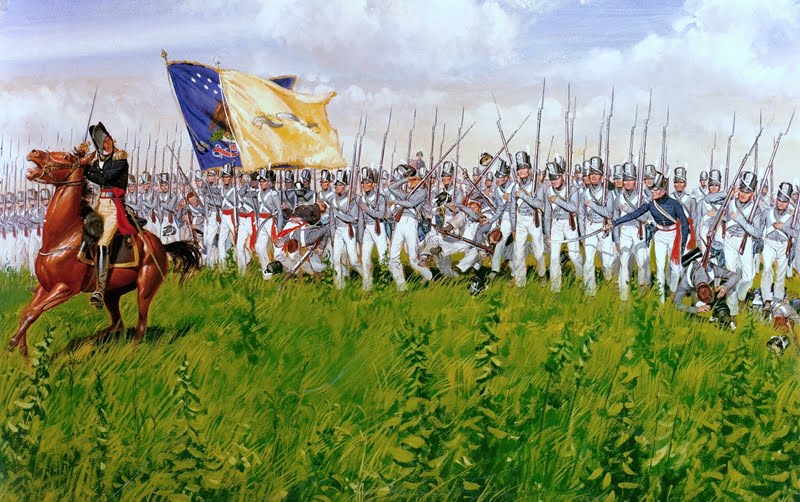
For several months prior to the battle General Scott had been drilling his green troops relentlessly in a camp at Flint Hill near Buffalo, NY, which town the British had burned to the ground just four months earlier. Scott recognized that without hard training and discipline his men would be in no position to face the British army, then the world's best. In a significant departure from frontier military practice at the time, he fought with army bureaucracy to ensure that the men were properly fed, clothed. and equipped, and enforced rigorous health and sanitary measures in the camp, which kept sickness to a minimum. His standards were thwarted only by the government's failure to supply the troops with proper blue uniforms; only short gray jackets typical of untrained militia were all that could then be provided.

To greatly simplify events: The Americans crossed the Niagara on July 3, and quickly captured British-held Fort Erie opposite Buffalo. On July 4, after firing a salute to America's 38th birthday, they moved north along the west side of the river and, late in the afternoon, encountered advance elements of Riall's force along Chippawa Creek. Following a brief exchange of artillery fire, Scott withdrew a few miles to camp along Street's Creek to the south. The next morning the British force advanced south and collided with Scott's brigade, which was just starting north. The clash opened with the American artillery battery all but wiping out out Riall's guns along the portage road along the river. Meanwhile, Scott formed his line into a "U" shape as the British line advanced, which allowed the American flanking units to catch Riall's advancing troops in a deadly crossfire. Riall had thought that the American line was composed of grey-clad militia troops apt to fall back in disarray after the opening volleys, but as Scott's men held steady under British artillery fire, Riall realized his mistake and supposedly exclaimed, "Those are regulars, by God!" After the two lines had punished each other with continuous volley fire for almost a half hour, at a distance of less than 100 yards, Riall ordered his men to withdraw back north. Only effective covering fire by British artillery kept the Americans from pursuing Riall's force all the way back to Chippawa (here's a detailed map showing locations and troop movements involved in the battle).

The British/Canadian/Indian force suffered an approximate casualty total of 106 killed, 325 wounded, and 90 taken prisoner---one-quarter of their entire strength. The American official casualty return stated their loss as 60 killed, 249 wounded and 19 missing, or slightly less than ten percent.

The two forces would meet again 19 days later and a few miles further north in the even more bloody Battle of Lundy's Lane, at the site of present-day Niagara Falls, Ontario. There too, the British/Canadian brigade would suffer a tactical defeat, although by this time American forces were so tired and depleted that they had to retreat back across the Niagara, without effecting the hoped-for conquest of Upper Canada.

Nevertheless, as noted by historian Donald E. Graves (the foremost authority on the Niagara Campaign), the Battle of Chippawa was the "first time during [the War of 1812] that American infantry had met and defeated British infantry in open battle." [Where Right and Glory Lead! The Battle of Lundy's Lane, 1814 (2d ed. 2003, p. 92)]. The American victory, made possible by General Scott's careful preparation of the troops at Flint Hill and his skillful leadership on the battlefield, showed clearly that the new nation's army had become a professional military force able to hold its own against the world's finest. Graves and many other historians thus suggest that Chippawa, rather than Valley Forge, might be considered the birthplace of the modern American army. Indeed, tradition has it that gray uniforms were later adopted for cadets at West Point--and are still worn today--in recognition of what Scott's brigade achieved at Chippewa.

So--WHY WASN'T I TAUGHT ABOUT THE BATTLE OF CHIPPAWA IN SCHOOL? On Grand Island, our little fannies were sitting not 5 miles from where the battle was fought! The main American force was led by a man who, cutting his teeth on that field as a newly-minted brigadier, later became one of the foremost military leaders in our nation's history! By the time of Chippawa there wasn't a corner of western New York that hadn't been hit hard by the war, between marauding British troops and refugees fleeing east by the thousands. The struggle along the Niagara in 1814 would determine the political future of this continent. And much of it happened literally in our back yards!

It's a shame that such events aren't taught more completely and effectively in our schools, especially when they're so immediate to the places where we live. If history is taught as if by reading from a telephone book--mere names, dates, places--young people (as well as old) can't help but be bored to death. They won't care about it and will never grasp the significance of what happened or be able to apply history's lessons in helping guide our country's future. But if history is made local and literally brought "home" to them--if it's made as familiar and immediate as their school building or the street on which they live--children will be captivated by how "real" it is and how directly it has affected their own lives. Only then will they gain the knowledge, experience, and perspective they'll need as future leaders to steer America on the right course.

POSTSCRIPT: You can visit the Chippawa Battlefield Park today and see the site almost exactly as it was on July 5, 1814--just an open field ringed by woods, yet now the eternal resting place for scores of men who fell that day, on both sides. An impresive monument (fittingly, one for both forces) commemorates their valor. I've been there, and the quiet is truly sobering when one thinks of the desperate struggle across that very ground so many years ago.

Sunday, July 4, 2010

HAPPY ANNIVERSARY!

Today is not only the 234th anniversary ouf our nation's founding, it's also the 29th anniversary of my family's founding (well, our little piece of the clan, anyway)! How ironic that Melany Dianne Spendlove and I tied the knot, and thus became forever dependent on each other, on July 4, 1981--"Independence" Day! That just happened to be the only Saturday in the mid-June-to-mid-July time frame that the that the minister and church we wanted for our wedding were available. What a wonderful day! Our families came down to Chattanooga, Tennessee where I was living and working at a law firm at the time, to share the event with us. We put the reception together ourselves, with lots of help from our kin, and stayed that night at the Chattanooga Choo Choo Hotel, in a luxurious Victorian railroad sleeping car (on a track by the hotel, not out in some grimy switchyard!). I couldn't tell you whether folks in Chattanooga were setting off fireworks that night, as Melany and I were too busy making our own! ;-)

That was only the first day of a journey together that will never end. Doesn't that give a dramatic perspective to one's wedding day?

I never stop marvelling at how miraculously improbable our union is. How did a the son of a milk truck driver/insurance salesman from western New York and the daughter of an auto worker from central Michigan get together, anyway (it's a long, amusing story)? We're so different--I was a timid, reserved, bookish, somewhat gloomy person, utterly lacking in practical skills, while she was (and still is) sunny, outgoing, optimistic, generous, and amazingly clever. And good. And wise. What on earth did she see in me? The wonderful thing is that we're still growing as people and discovering more and more of each other every day, even 29 years on. We help each other be all that we can be. Each of us feels like half a person when the other is away, and can't imagine life without the other. We've had at least our share of rough stretches along the way, thanks largely to our own shortcomings (well, mine anyway), but somehow we've managed to surmount them with faith, dogged commitment, and all the love we could muster. God willing, we'll have at least another 29 years here on earth to test and grow our skills as spouses!

HERE'S TO US, HONEY!