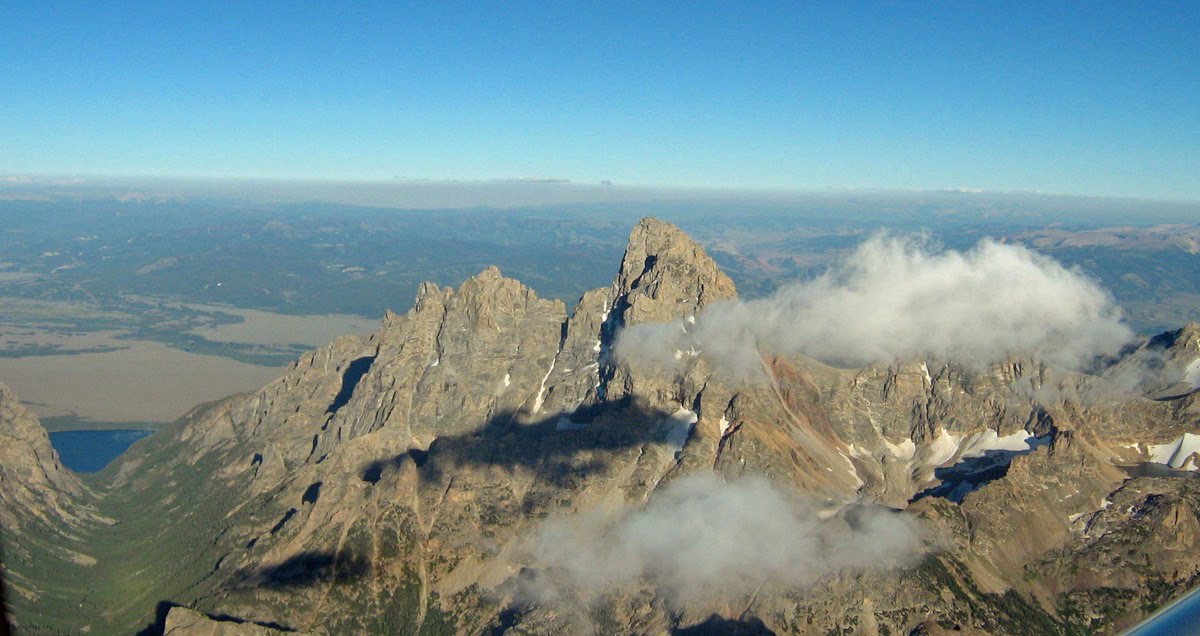
 Of course, it wasn't enough for me merely to view the Teton Range from more than two miles in the air during our recent western vacation. A couple of days after that breathtaking event, my family and I drove from Donna and Jonathan's home in Idaho Falls to Grand Teton National Park--which is located in northwestern Wyoming, just south of Yellowstone National Park--to see those mountains from the ground, in all their towering majesty!
A little background: The Tetons were supposedly named by French explorers who called the three highest peaks of the range Les Trois Tetons (um, "the three breasts" in French). In addition to 13,770 ft-high Grand Teton Mountain, eight peaks in the Teton Range are over 12,000 feet above sea level. The entire range is about 40 miles long, and is the youngest in the Rocky Mountains. Unlike most mountain ranges, the Tetons lack foothills, and rise sharply from 5,000 to nearly 7,000 feet above the floor of a beautiful and historic valley called Jackson Hole. The largest nearby town, just south of the Park entrance, is Jackson, Wyoming.
It took us less than a full morning to drive through Grand Teton National Park, even with numerous stops for pictures. I wasn't able to take notes of the precise peaks I was photographing or of each particular place from which I was taking them, so here I can only present my best photos in rough order of their taking, and let you take in the incredible beauty of these mountains. Don't forget to click on them for much bigger and more detailed views!


 Of course, no tourist experience is complete without a shot of yourselves standing in front of whatever natural wonder you have traveled to see!
 We drove on from where these pictures were taken, and snapped a few more from the northern end of the Tetons looking south.

 Not far from the northern entrance to the Park we stopped for a picnic lunch on the shores of Jackson Lake, which lies directly to the east of the Tetons. That's Melany in the lower right corner of the picture below!
 Still more spectacular views were presented from the causeway above Jackson Lake Dam.

 Only a short distance further up the road and we were out of Grand Teton National Park and into Yellowstone National Park! We've visited there several times before--someday, I'll have to scan my pictures from those trips and put them up on this blog--so we didn't plan on tarrying there too long. Our actual destination was Yellowstone's west entrance, a little over an hour's drive north from the Tetons. But we did make a pit stop at the visitors' center near Old Faithful geyser, and just happened to be there when she "blew" at about 2:35 p.m. That was something we hadn't seen on previous Yellowstone visits, so it was an unexpected treat!
 Interesting factoid: According to Wikipedia, Old Faithful was sometimes used as a laundry during the Park's early days; garments placed in the crater during the geyser's quiet periods were ejected thoroughly washed when the eruption took place!
Driving beyond Old Faithful, we encountered this big fellow sunning himself just off the road--what visit to Yellowstone would be complete without seeing bison (as much our national animal as the bald eagle, in my opinion)!
 We finally reached the western entrance to Yellowstone and our destination just beyond: West Yellowstone, Montana (yes, this one-day trip took us from Idaho to Wyoming to Montana, and eventually back into Idaho!). This is a small, slightly kitschy, but fun "western" town full of shops and restaurants that cater to the Yellowstone/Grand Teton visitors--but it's not gaudy and tasteless enough to qualify as a "tourist trap." We did a little shopping, and after some coaxing I was persuaded to try on a ridiculous hat supposedly made from the fur of some animal (I didn't know they had such animals in China!)
 After a nice barbecue dinner (I had something called a "Mad Dog," a spicy sausage wrapped in barbecued beef brisket on a hoagy roll), we walked over to a place called the Playmill Theatre to see a delightful production of the stage musical Seven Brides for Seven Brothers. Donna had heard about this place and got us all tickets ahead of time. If you've ever seen the film version, you know that this was the most perfect play you could possibly see after a visit to Yellowstone!
 What made the experience really special was the theater and the cast, and the way they presented the show. The theater, in a throwback western wood-frame building, is very cozy and seats probably no more than 120 people. The stage is semi-round and projects well into the audience, so the place is very intimate. The greatest thing, however, is the cast--they're all young people attending colleges in the southeastern Idah0-northern Utah region, and spend the whole season together acting at the Playmill. Are they ever talented and entertaining! They'd better be--the theater presents three different productions on different nights of the week all summer long, which means the cast has to know the dialogue, choreography, and music for three full-length shows simultaneously! And they don't just act--they usher before the show starts, and go out in the audience selling refreshments (soda, popcorn, and homemade fudge) during the intermission, in their costumes, makeup, and stage personas! Before the main production they come out individually or in small groups on stage and with the greatest enthusiasm and skill perform old-time musical numbers and comedy skits, all clean and family-appropriate. One suspects that vaudeville was just like this in its prime, when it was all the (legitimate) entertainment available in most small towns, at least outside church halls and school dances. What a wonderful and unique thing to experience today!
 After the play we started back to Idaho Falls--by now it was after 9 p.m.--but took a wrong turn somewhere and drove at least 20 minutes north toward Bozeman, Montana (a classic frontier town)! Once the mistake was realized we decided that it was God's way of sending us back to West Yellowstone for some homemade ice cream before returning home--so that's just what we did! We're still joking about it.
We finally got to Idaho Falls not long before midnight, exhausted but happy after one of the most delightful days we've ever spent! Thanks so much to Donna and Jonathan for making it happen!




 Posts
Posts


